Most advice on personal branding tells CEOs to “post more” and “just be authentic.” That’s not a strategy – it’s a vibe. And it’s part of why so many executives avoid personal branding altogether: nobody wants to become the founder who suddenly starts posting daily motivational quotes.
Here’s the good news. Personal branding for CEOs isn’t about becoming an influencer. It’s about making sure that when someone searches your name, meets you at a summit, or considers doing business with your company, what they find matches who you actually are – instead of letting silence, or worse, someone else’s narrative, fill that gap. Done right, it’s one of the highest-leverage, lowest-cost investments a CEO can make.

Here’s how to do it without it feeling forced.
1. Start With Substance, Not a Content Calendar
The biggest mistake executives make is starting with “what should I post” instead of “what do I actually know that’s useful?” Your personal brand should be a byproduct of your expertise, not a marketing exercise layered on top of it.
Before writing a single post, get specific about three things:
- Your core expertise: The two or three areas where your operating experience genuinely gives you an edge
- Your point of view: Where you disagree with conventional wisdom in your industry, and why
- Your audience: Who actually needs to hear this: investors, customers, talent, peers, or media
A CEO who tries to speak to everyone ends up saying nothing useful to anyone. Narrow it down, and the content becomes far easier to create because you’re not searching for topics- you already have them.
2. Let Your Company Story and Your Personal Story Reinforce Each Other
Your personal brand doesn’t compete with your company brand- it should support it. The most credible executive brands are the ones where the CEO’s personal story and the company’s mission are clearly connected: why you started the company, what problem you’re obsessed with solving, what you believe that most people in your industry don’t.
This is also where authenticity does real work. Being open about your role – that you’re building the company, not hiding behind it – is far more credible than pretending to be a neutral commentator. Audiences can tell the difference between an executive sharing genuine perspective and one performing thought leadership for engagement.
3. Pick Two Channels and Go Deep, Not Five Channels and Go Thin
You don’t need to be everywhere. For most B2B executives, LinkedIn is the primary channel, because it’s where investors, customers, and peers are already paying attention professionally. A second channel – a podcast, a byline in an industry publication, or speaking engagements – usually does more for credibility than adding a third or fourth social platform.
Consistency matters more than frequency. A CEO who publishes one genuinely useful post a week for a year builds more trust than one who posts daily for three weeks and disappears.
4. Speaking and Media Beat Posting for Credibility
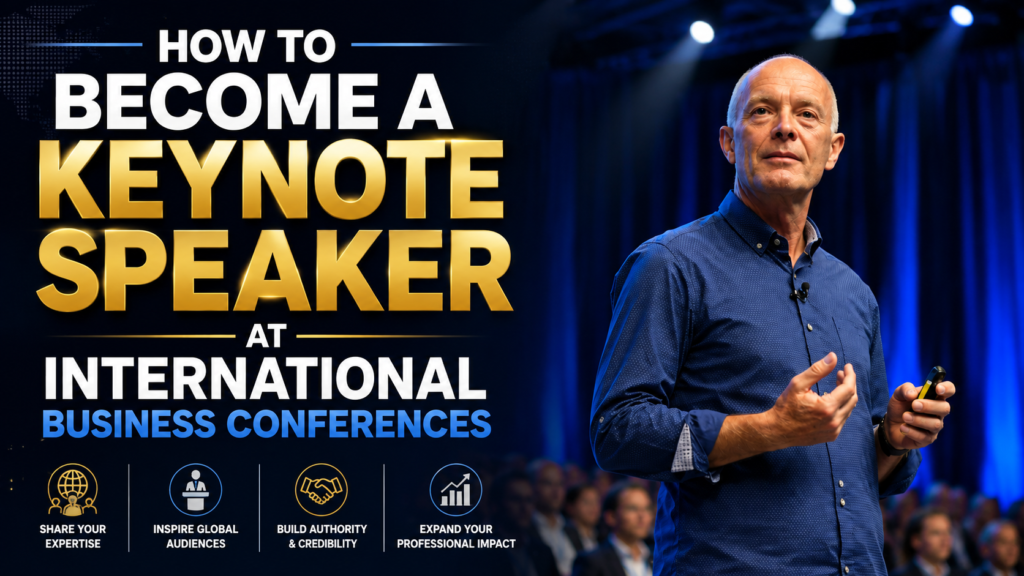
If you only have time for one high-leverage activity, make it speaking. Delivering a talk, sitting on a panel, or appearing on a podcast conveys expertise in a way that a text post simply can’t – tone, command of the material, and how you handle questions all build trust faster than any caption. It also gives you content to repurpose: a single keynote or podcast appearance can become several weeks of posts, clips, and quotes.
Industry bylines work the same way. A well-placed article in a trade publication does more for long-term credibility than the same content published only on your own feed, because it borrows the publication’s authority.
5. Manage Your Narrative Proactively, Not Reactively
Search your own name periodically. If outdated or irrelevant information ranks above anything current, that’s a signal to publish more relevant, recent material – not necessarily to try to remove the old content. The strongest defense against an inaccurate or outdated impression of you online is a steady stream of accurate, recent material that naturally outranks it.
This matters more than most executives assume. In the absence of a clear, verified narrative from you, others – journalists, competitors, or increasingly, AI systems summarizing “who you are” from whatever’s publicly available – will fill that gap with whatever they find first.
6. Treat It Like a Long-Term Asset, Not a Campaign
Personal branding compounds. A CEO who starts publishing consistently now, well before they feel “important enough” to have a platform, will have a meaningfully stronger position in two or three years than one who waits until they need it – during a fundraise, a crisis, or a job search. By then, it’s much harder to build credibility from zero under pressure.
A Quick Success Story
Take a mid-market manufacturing CEO – call him David. For years, his company’s growth came entirely through referrals and trade show relationships. He had no online presence beyond a static LinkedIn profile, and when a supply-chain issue became public, a competitor’s take on the story ranked above anything from David or his company for weeks.
Rather than hiring an agency to manage a full content calendar, David picked one narrow lane: writing short, specific posts twice a month about the operational lessons from rebuilding his supply chain, paired with two podcast interviews on the same topic over six months. Nothing polished, nothing performative – just real detail from someone who had actually lived it.
Within a year, his name started surfacing in searches attached to his own perspective rather than the old incident. A conference organizer found one of his posts and invited him to speak on a panel, which led to two more speaking invitations and, eventually, an inbound partnership enquiry from a company that said they’d found him through a podcast clip a colleague had shared. None of it required a large following – just consistency around a narrow, credible story.
Final Thought
Personal branding for CEOs isn’t about volume, and it isn’t about performing a version of yourself that feels foreign. It’s about making your actual expertise and perspective findable, before someone else – or something else – fills that space for you. Pick a narrow lane, lean into speaking and media alongside writing, and let it compound. That’s the whole non-cringe version of the strategy.